
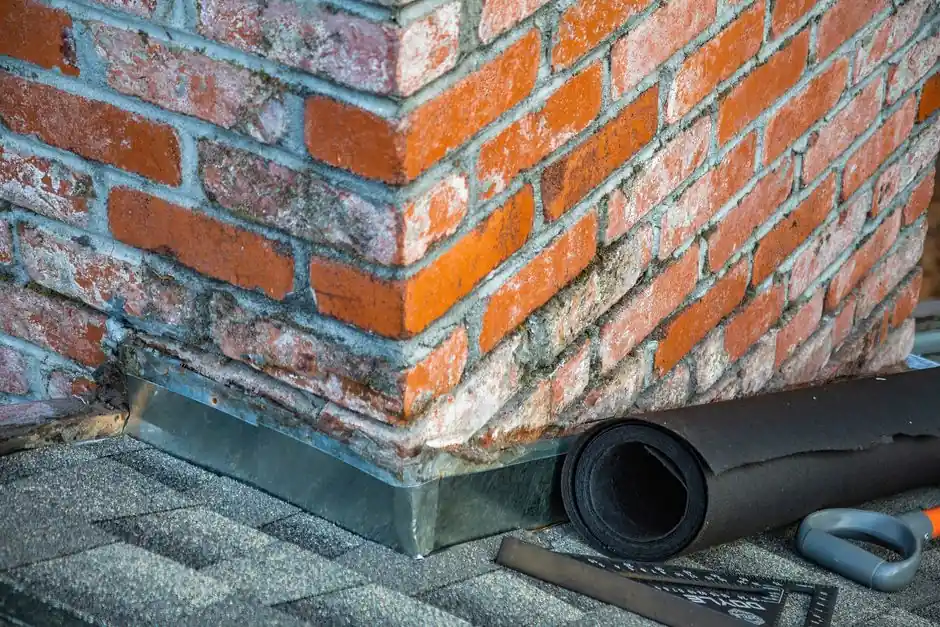
Chimney flashing leaking in Florida almost always traces back to one of four things: failed sealant at the masonry joint, rusted or corroded metal, storm-driven water forced under the flashing, or a chimney that has shifted away from the roof deck. The fix depends on which one you have, and the wrong fix - like smearing more caulk on top - buys you a few months at best. This guide walks through the real causes we see on Florida roofs, what a proper repair looks like, what it costs in 2026, and when it's time to call us instead of climbing up there yourself.
Why Is My Chimney Flashing Leaking in Florida?
Chimney flashing leaking in Florida happens because the flashing - the layered metal that seals the gap between your chimney and the roof - has lost its watertight seal, and Florida's sun, rain, and wind push water through that gap faster than most homeowners expect. Flashing is a system, not a single piece of metal. It includes step flashing woven into the shingles, counter-flashing embedded in the chimney mortar, and a base or apron flashing at the low side of the chimney. When any one of those pieces fails, water finds the path of least resistance and shows up on your ceiling, usually far from the chimney itself.
That last part trips people up. A stain on the ceiling in a hallway ten feet from the chimney is often a chimney flashing leak. Water travels along rafters and decking before it drips. So the location of the stain is not where the leak is - it's where the water finally broke through.
The Most Common Chimney Leak Causes in Florida
Chimney leak causes in Florida are different from what you'd see in colder states. We don't get ice dams. We get 90-plus-degree afternoons, afternoon thunderstorms that dump two inches in an hour, and hurricane-season wind that drives rain sideways into places it was never meant to go.
1. Failed sealant at the counter-flashing joint
The most common cause we find is deteriorated sealant where the counter-flashing meets the chimney's brick or stucco. Florida's UV index breaks down standard caulk in 3 to 5 years. Once it cracks, water runs straight down behind the flashing and into the attic.
2. Rusted or corroded flashing metal
Galvanized steel flashing rusts through in 10 to 15 years in coastal Florida air. Once rust eats a pinhole, the flashing is done. Patching it is a waste of money.
3. Storm damage and wind-driven rain
Hurricane-season winds of 60 to 100 mph lift flashing edges and tear sealant lines. Even a tropical storm that doesn't damage your shingles can compromise your chimney flashing. If you've had a storm in the last 12 months, that's a prime suspect.
4. Chimney settlement or mortar deterioration
Chimneys are heavy. Over decades, they can settle slightly away from the roof, opening a gap the flashing can no longer bridge. Cracked mortar crowns and spalling brick let water in above the flashing line, too.
5. Wrong flashing material or installation
We regularly find chimneys where someone used roof cement instead of proper step flashing, or skipped the counter-flashing entirely. That work fails - it's just a matter of when.
How Do I Fix a Chimney Flashing Leak in Florida?
Fixing a chimney flashing leak in Florida means removing the failed flashing, replacing it with new metal properly layered into the roof system, and sealing it with a polyurethane or silicone sealant rated for high UV. There is no shortcut that lasts. Here's the sequence our technicians follow:
- Find the actual leak point. We inspect from the attic first, then the roof, then the chimney itself. Water staining on the roof deck tells us where it's entering.
- Remove the old flashing. Step flashing, counter-flashing, and any roof cement get pulled out. We don't layer new metal over failed metal.
- Repair the substrate. If the mortar joint is cracked or the roof deck is soft, that gets fixed before new flashing goes on.
- Install new flashing. Copper or 24-gauge galvanized steel, depending on your roof and budget. Copper lasts 50-plus years in Florida; galvanized lasts 15 to 25.
- Seal and test. We seal the joints with UV-rated sealant and run a water test before we leave.
If the leak is coming from a different penetration - a pipe boot, a vent, or a shingle field - the repair is different. Our chimney flashing repair Florida service covers all of it, and we'll tell you straight if the chimney isn't the problem.
How Much Does Chimney Flashing Repair Cost in Florida?
Chimney flashing repair in Florida runs $350 to $1,200 for most residential jobs in 2026, with full flashing replacement typically landing between $800 and $2,500 depending on chimney size, roof pitch, and material. Here's how that breaks down:
- Sealant refresh only: $150-$350. Only appropriate when the metal is sound and just the sealant has failed.
- Partial flashing repair: $350-$800. One or two sections of step flashing replaced.
- Full flashing replacement: $800-$2,500. All flashing removed and replaced with new metal.
- Flashing plus chimney masonry repair: $1,200-$4,000+. Needed when mortar or brick is also failing.
Two things drive the price up fast: a steep or tile roof (harder to walk and work on) and a chimney that's taller than 8 feet above the roof line. Coastal homes in areas like Roof Leak Repair in Anna Maria often need copper rather than galvanized because of salt air, which adds cost but lasts three times as long.
What you should not do is pay for a repair that's really just a caulk-and-pray job. If a quote doesn't include removing the old flashing, it's not a repair - it's a delay.
Can I Repair Chimney Flashing Myself in Florida?
You can repair chimney flashing yourself in Florida if the problem is only failed surface sealant and you're comfortable on a roof - but anything involving the metal itself, the mortar joint, or the roof deck is a job for a professional. Here's the honest line:
DIY-appropriate: Re-caulking a visibly cracked sealant line with a high-quality polyurethane sealant on a dry day, on a low-slope roof, with no visible rust or lifting metal.
Not DIY-appropriate: Replacing step flashing, counter-flashing, or apron flashing. Repairing cracked mortar. Any leak where you can't see the entry point. Any roof above one story. Any tile or metal roof, where walking on it wrong causes more damage than the leak.
The other issue is diagnosis. Most homeowners who call us have already tried caulk once or twice. The leak came back because the caulk wasn't the problem - the metal underneath was already compromised. If you've sealed it once and it's leaking again, stop sealing and get it looked at. Our Emergency Roof Leak Repair in Florida team handles same-day diagnosis when water is actively coming in.
Common Mistakes We See on Florida Chimney Repairs
The mistakes we see on Florida chimney repairs almost always come from skipping a step to save time or money. Here are the ones that cost homeowners the most:
- Caulking over rusted flashing. The caulk sticks to rust for one season, then peels. You've spent $200 and bought six months.
- Using roof cement as flashing. Roof cement is a patch, not a flashing system. It cracks in Florida heat within 18 months.
- Skipping the counter-flashing. If the flashing isn't embedded into the chimney mortar, water gets behind it every time.
- Sealing on a wet roof. Sealant won't bond to a damp surface. If it rained this morning, the repair waits.
- Ignoring the chimney crown. A cracked crown lets water into the chimney itself. Fix the flashing, and you'll still have a leak.
- Hiring the cheapest quote. The lowest bid is almost always the one that skips removing the old flashing.
We also see homeowners ignore the problem because the leak only shows up during heavy rain. That's a mistake. Every storm that gets through adds moisture to your attic insulation, your drywall, and eventually your framing. A $500 flashing repair today prevents a $4,000 ceiling and insulation replacement next year.
When to Call a Professional
Call a professional when water is actively entering, when you can't find the leak point, when the flashing metal is rusted or lifted, or when the chimney mortar is cracked. Those are the four situations where DIY work makes the problem worse or just delays it.
At Emergency Roofing Service, we handle chimney flashing repair across Florida, from single-family homes to older properties with original masonry chimneys. We find the leak, replace the failed flashing with new metal, seal it with UV-rated materials, and water-test before we leave. If the leak turns out to be somewhere else - a pipe boot, a shingle field, or storm damage - we'll tell you and fix that instead. No guesswork, no upselling you a flashing job you don't need.
If you're in an area like Roof Leak Repair in Vero Beach or anywhere else along the coast, salt air and storm season make flashing failure more likely, not less. The sooner it's fixed, the less damage you're paying for later.
Frequently Asked Questions
Why is my chimney flashing leaking in Florida?
The most common cause is failed sealant where the counter-flashing meets the chimney, followed by rusted flashing metal and storm-driven water. Florida's UV and hurricane-season wind break down flashing faster than in most states - sealant typically fails in 3 to 5 years.
How do I fix a chimney flashing leak in Florida?
Remove the old flashing, repair any cracked mortar or soft roof deck, install new copper or galvanized flashing layered into the roof system, seal the joints with UV-rated sealant, and water-test. A proper repair takes 3 to 6 hours for most residential chimneys.
How much does chimney flashing repair cost in Florida?
Expect $350 to $1,200 for most repairs in 2026, and $800 to $2,500 for full flashing replacement. Jobs that also involve chimney masonry repair can run $1,200 to $4,000 or more. Steep roofs and tall chimneys push the price toward the higher end.
Can I repair chimney flashing myself in Florida?
Only if the issue is a cracked sealant line on a low-slope roof you can safely walk. Replacing metal flashing, repairing mortar, or working on tile and metal roofs should be done by a professional - the risk of making the leak worse is high.
How long does chimney flashing last in Florida?
Galvanized flashing lasts 10 to 15 years in Florida's coastal air. Copper lasts 50-plus years. Sealant lines need refreshing every 3 to 5 years regardless of the metal, because UV exposure breaks down caulk faster here than almost anywhere else.
Get Help with Roof Leak Repair in Florida
If your chimney flashing is leaking, we can stop it - usually the same day you call. Our team handles Roof Leak Repair in Florida for homeowners across the state, from chimney flashing to storm damage to full roof leak diagnosis.
Call us at +18506353106 and we'll get a technician out to find the leak, fix it right, and confirm it's dry before we leave.